
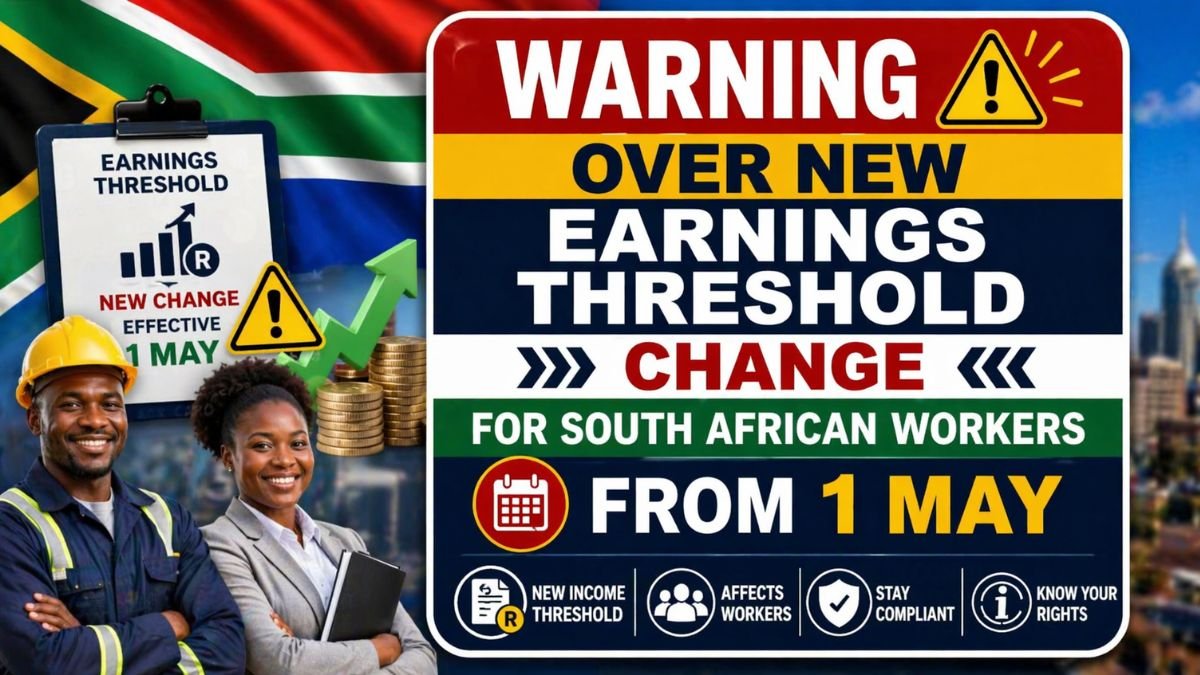
A major workplace change will take effect in South Africa on 1 May 2026, as the earnings threshold rises to R269,601 per year (about R22,467 per month).
This update could directly affect both employers and employees, with some workers losing automatic protections under the Basic Conditions of Employment Act (BCEA), while others gain them.

Experts are urging businesses to review contracts, working hours, and payroll structures before the changes come into force.
What Is Changing on 1 May 2026?
The updated earnings threshold was gazetted on 17 April 2026 and becomes effective on 1 May 2026. It reflects an increase of around 3%, moving up from roughly R22,100 per month in 2025 to R22,467 per month in 2026.
The earnings threshold is important because it determines whether certain BCEA protections apply automatically to an employee. Anyone earning above that amount may no longer qualify for those protections by default, while those earning below it may now be covered.
Why Employers Have Been Warned

Legal experts at Werksmans Attorneys said the change could have real financial consequences for employers. Businesses may need to budget for higher overtime costs, tighter work-hour controls, and additional compliance requirements.
Employers have also been advised to review employment contracts and remuneration structures. This is especially important where staff are close to the threshold, as a small shift in classification could change what protections apply.
If employers do not assess these changes properly, they may face unintended breaches of labour law.
BCEA Protections Linked to the Threshold

Employees who earn below the threshold may automatically qualify for protections relating to:
- Ordinary hours of work
- Overtime
- Meal intervals
- Rest periods
- Sunday work
- Night work
- Public holiday pay
These protections are designed to support fair labour practices and regulate working conditions. For employers, this means more careful management of staff schedules and pay obligations.
Other Legal Risks for Employers
The impact goes beyond the BCEA. According to Bowmans, employees earning below the threshold may also receive added protections under the Labour Relations Act, especially in atypical work arrangements.
For example, workers on fixed-term contracts may be regarded as permanent employees if there is no valid reason for limiting the contract period. In addition, staff supplied by labour brokers could be treated as employees of the client if they are not performing a temporary service.
This makes it even more important for employers to review temporary and outsourced staffing arrangements.
Key Information
| Item | New Position |
|---|---|
| Effective date | 1 May 2026 |
| Annual threshold | R269,601 |
| Monthly equivalent | About R22,467 |
| Main impact | Some workers gain or lose automatic BCEA protections |
What Counts as Earnings?
Legal experts have stressed that “earnings” in this context do not mean every payment made to an employee. Earnings generally refer to regular annual pay before deductions such as tax, pension, and medical aid.
However, certain payments are excluded, including:
- Transport allowances
- Subsistence allowances
- Achievement awards
- Overtime payments
This distinction matters because using the wrong calculation could lead to employers wrongly placing workers above or below the threshold.
Conclusion
South Africa’s new earnings threshold could bring meaningful changes to the workplace from 1 May 2026. Employees below the new limit may gain stronger protections, while employers may face higher compliance and labour costs.
With the change now confirmed, businesses should review staff earnings, contracts, and work arrangements as soon as possible to avoid legal and financial risks.
