
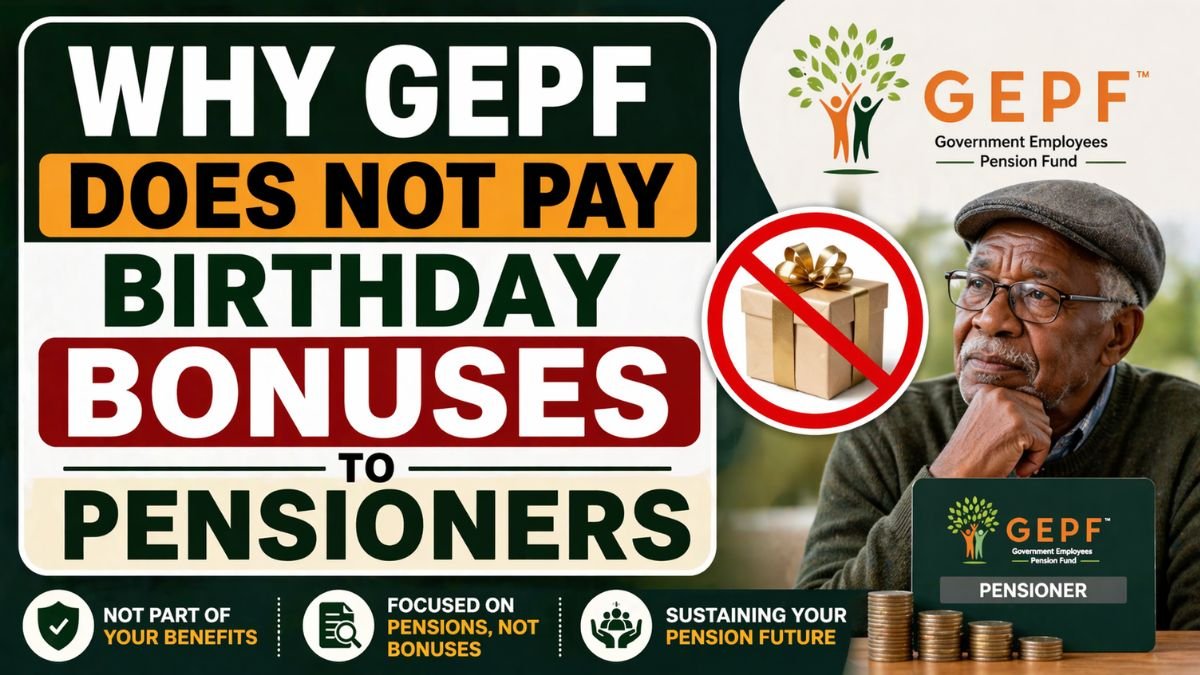
The Government Employees Pension Fund (GEPF) has clarified why it does not offer birthday bonuses to pensioners. Instead of once-off payments, the fund focuses on providing stable, inflation-linked increases to ensure long-term financial security for its members.
GEPF’s Focus Is on Sustainable Pension Growth
According to the fund, its pension structure prioritises annual increases that help pensioners keep up with inflation. Instead of paying a lump sum during a pensioner’s birthday month, GEPF directs its resources toward maintaining stable monthly pensions and annual adjustments.

The fund explained that pension policies differ from one retirement fund to another. While some funds may choose to pay birthday bonuses, those payments may come at the cost of lower monthly pensions or smaller general increases over time.
GEPF believes that its current system offers a more balanced and reliable way to support pensioners, especially during periods of rising prices and economic pressure.
Why Some Funds Offer Birthday Bonuses
GEPF noted that each pension fund operates according to its own rules, financial model, and affordability limits. This means there is no one-size-fits-all approach in the pension sector.

Some retirement funds may decide to provide a bonus in the month of a pensioner’s birthday. However, GEPF stressed that such bonuses are not “free” benefits. In some cases, they may be linked to reduced annual increases or lower regular pension payments.
The fund’s position is that whatever method is used, it must be affordable and suitable for the specific pension fund. For GEPF, that means putting more emphasis on consistent support rather than discretionary lump-sum payments.
Four Types of Pension Increases Available Under GEPF
GEPF said its Board has four levels of increases it can declare, depending on the financial position of the fund and inflation conditions. These include:
- A basic increase
- A further inflation-related increase
- A catch-up increase
- A supplementary increase

This structure gives the fund flexibility to respond to economic conditions while still protecting its members’ pensions over time.
Rather than allocating money toward birthday bonuses, GEPF uses this framework to manage pension increases in a way that supports long-term affordability and fairness.
3.5% Pension Increase from April 2026
The fund recently confirmed a 3.5% increase for pensioners from 1 April 2026. This adjustment was based on the latest inflation figures and is intended to help pensioners cope with the rising cost of living.
Pensioners who retired on or before 1 April 2025 qualify for the full 3.5% increase. Those who retired after that date will receive a proportional increase based on how many months they had been receiving their pension by 31 March 2026.
This approach shows that GEPF is focused on linking pension adjustments to actual economic conditions instead of offering occasional once-off payments.
Key GEPF Pension Update at a Glance
| Item | Details |
|---|---|
| Birthday bonuses | Not offered by GEPF |
| Main reason | Focus on inflation-linked increases and sustainability |
| Increase effective date | 1 April 2026 |
| Full pension increase | 3.5% |
| Who gets full increase | Pensioners retired on or before 1 April 2025 |
| Pro-rated increase | Applies to those retired after 1 April 2025 |
What This Means for Pensioners
For pensioners, the message from GEPF is clear: the fund prefers a dependable pension model over symbolic or once-off benefits. While birthday bonuses may sound appealing, GEPF argues that stable annual increases provide more meaningful long-term value.
This is especially important in an environment where pensioners face higher food, transport, electricity, and healthcare costs. A pension system that keeps pace with inflation may ultimately be more beneficial than occasional bonus payments.
Conclusion
In summary, GEPF prioritises consistent pension growth over one-time bonuses. While birthday payouts may seem appealing, the fund’s approach aims to deliver more reliable financial support by aligning increases with inflation and maintaining sustainability.
